

.svg)
Hearing that your child needs to be put under general anesthesia for dental work is one of the most stressful moments a parent can face. It is a significant medical procedure, and it is entirely normal to feel anxious, overwhelmed, and unsure of what to do next.
If you have recently received this recommendation from another dental office, we want you to know two things right away: First, your concern is valid. Second, general anesthesia is rarely the only option.
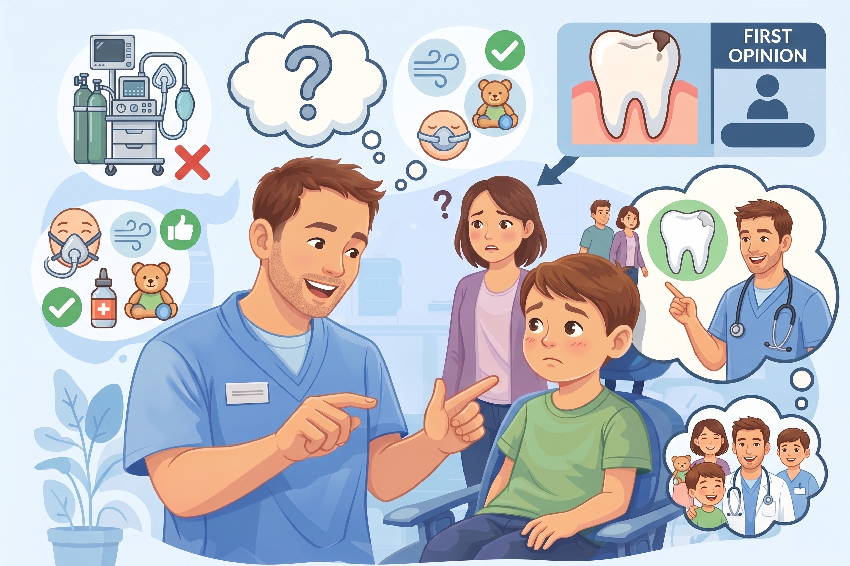
At Children's Dentistry of Redding, we frequently see families who come to us seeking a second opinion after being told their child must be put under. In many of these cases, we are able to complete the necessary treatment safely and comfortably without resorting to general anesthesia. Here is what you need to know about your options and why a second opinion is always a good idea.
General anesthesia has a legitimate and important place in pediatric dentistry. It is a valuable tool that allows dentists to perform complex or extensive procedures safely.
There are certain situations where general anesthesia is genuinely the best option. These typically include cases where a child has severe, widespread decay that requires multiple extractions or complex restorations, or when a child has specific special healthcare needs that make traditional treatment impossible. In these specific scenarios, general anesthesia ensures the child is completely asleep, feels no pain, and has no memory of the procedure, allowing the dentist to complete all necessary work in a single, controlled environment.
However, the reality is that these cases are the exception, not the rule. The problem arises when general anesthesia is presented as the default solution rather than a carefully considered last resort.
Every medical procedure carries some level of risk, and general anesthesia is no different. While it is generally safe when administered by a qualified anesthesiologist in a proper setting, it still involves putting a child into a state of deep unconsciousness. It requires careful monitoring, carries a small risk of complications, and involves a recovery period.
Because of these factors, we believe that general anesthesia should only be recommended when all other, less invasive options have been exhausted or ruled out. If a child has a few cavities, or if the decay is early and not causing pain, jumping straight to general anesthesia is often an unnecessary escalation of care.
When a family comes to us for a second opinion, our goal is not to judge the previous recommendation, but to provide a complete picture of all available options. We believe parents deserve to be treated as intelligent adults who can make informed decisions when given all the facts.
Our approach is built on looking at the child as a whole person, not just a set of teeth. We ask a series of questions to determine the true urgency and impact of the dental issues:
• ❓ Is the child in pain?
• 🍽️ Is the dental issue affecting their ability to eat or sleep?
• 📚 Is it impacting their performance or focus at school?
The answers to these questions guide our treatment plan. If the decay is early and not causing discomfort, we often have several alternatives to general anesthesia.
If we catch decay early, and it is not causing pain or affecting the child's quality of life, the most conservative approach is often the best. We may recommend a strict modification of diet (reducing sugar frequency) and a rigorous at-home hygiene routine. We will take photos and X-rays to establish a baseline, and then reevaluate the teeth in six months. Often, with excellent home care, early decay can be arrested or significantly slowed, avoiding the need for immediate invasive treatment.
If treatment is necessary, we do not always have to do everything at once. We use a priority-based approach. This means we focus first on the specific teeth that are causing pain or are at immediate risk of infection. We treat the most critical issues to improve the child's immediate quality of life—"better today, better tomorrow." The less critical issues can be monitored or treated at a later date using less invasive methods.
Many children who are anxious or uncooperative in a standard dental setting can be successfully treated in our office without general anesthesia. As pediatric specialists, our team is trained in advanced behavior management techniques. We know how to talk to children, how to explain procedures in a non-threatening way, and how to create a calm, supportive environment.
When extra help is needed to keep a child comfortable, we frequently use nitrous oxide (laughing gas). Nitrous oxide is safe, fast-acting, and wears off quickly. It takes the edge off the anxiety and allows many children to sit comfortably through procedures that might otherwise seem impossible.
You always have options when it comes to your child's healthcare. If you have been told general anesthesia is the only way forward, we strongly encourage you to get a second opinion.
A second opinion from a pediatric specialist trained in behavior management, nitrous oxide, and gentle technique often reveals pathways the first office never offered. It gives you the information you need to make the best, most comfortable choice for your child.
At Children's Dentistry of Redding, we welcome second opinions. There is no pressure and no obligation. We simply provide a full conversation about what is actually going on and what all your options are.
If you are facing a difficult decision regarding your child's dental treatment, call us today at (530) 222-2473 or visit SmileRedding.com to schedule a consultation. We are here to help you find the best path forward for your family.